Contact mat vs laser jump tester
Two good tools that measure vertical jump, contact time, and RSI, built on completely different technology. Here's an honest, data-backed look at how they differ, including original ground-contact-time testing, so you can choose the right one for your program.
Different jobs, not just different brands
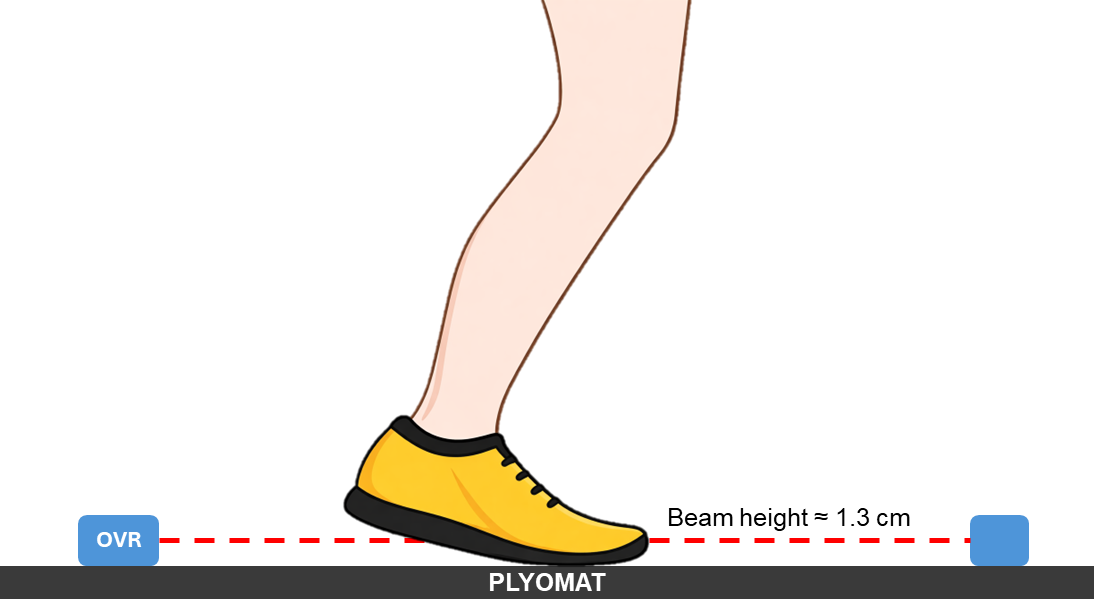
OVR Jump is a contactless laser-barrier sensor, two light bars project an infrared beam about 1.3 cm off the ground and detect when the foot crosses it. It genuinely wins where a mat can't go: approach jumps, outdoor and field testing, no landing surface required, and very light, fast setup.
Plyomat is a force-based contact mat, the athlete jumps on a polyurethane switch mat and the Controller 3.0 detects ground contact directly through force on the surface. It's built for consistent standing countermovement and drop-jump testing, with a force-plate-validated signal, an on-device screen for fast team testing, and rugged durability.
We won't pretend it's a price fight, OVR's single device is cheaper at entry, and both apps are free with no subscription. The real question is what kind of signal you want to make decisions on. That's where the testing below matters.
How the two systems define "contact"
A force-based mat and an optical laser don't measure the same instant. The mat registers force on the surface; the laser registers the foot breaking a beam ~1.3 cm up, a spatial event, not a mechanical one.
Contact-time bias, measured against video
Both field systems were compared to high-speed video (a consistent visual definition of contact) across drop jumps and running at slow, medium, and fast speeds.
Plyomat (force-based)
Consistent underestimate, low variability (~10–15 ms spread), same direction of error across jumping and running. Stable even as contact times shortened. A signal that "behaves the same way" trial to trial, which is what lets you trust a change.
OVR (optical laser)
Wider spread (~35 ms total), and the direction of error changed with the task (over- in drop jumps, mixed in running). Variability increased as speed increased and contact times got shorter, exactly the high-performance range coaches care about.
In drop jumps the ordering was stable, Plyomat < Video < OVR, across short- and long-contact strategies and different athletes. The takeaway isn't "one is right and one is wrong": each captures a different aspect of foot, ground interaction. But because switching systems can shift contact time by 20–40 ms in jumping and 10–30 ms in running, a less variable signal is easier to interpret over a season, and Plyomat's force-threshold method is more closely aligned with the mechanical loading coaches are actually trying to measure.
Plyomat vs OVR Jump
| OVR Jump | Plyomat | |
|---|---|---|
| Technology | Contactless laser barrier | Force-based contact mat |
| Measures | Jump height, contact time, RSI | Jump height, contact time, RSI, RSQ, Power Score, asymmetry |
| Jump-height method | Flight time | Flight time |
| Contact-time method | Optical beam break (~1.3 cm up) | Direct force on the surface |
| Contact-time consistency* | −10 to +25 ms, varies by task/speed | ~10–20 ms, stable across tasks |
| Force-plate validation | None published found | Yes (r≈0.97) |
| Outdoor / approach jumps | Yes (its strength) | Standing CMJ & drop jumps on the mat |
| On-device screen | Phone needed | Yes (Controller 3.0) |
| Setup / durability | Two optical bars, keep aligned | Rugged mat, no alignment |
| Entry price | ~$299 | Mats from $200 · systems from $750 |
| Subscription | None | None |
Choose the right tool
Choose OVR Jump if…
- You test approach jumps or need to measure outdoors / on the field
- You can't (or don't want to) put down a landing surface
- You want the lightest possible kit and lowest entry price
- You're buying into the OVR sprint + jump + velocity ecosystem
Choose Plyomat if…
- You run standing CMJ & drop-jump testing where contact time and RSI matter
- You want a force-plate-validated, consistent signal you can trust season to season
- You test full teams and want results on an on-device screen, no phone required
- You want RSQ, Power Score, and asymmetry, and rugged gear that lasts
Plyomat vs OVR Jump FAQ
What's the difference between Plyomat and OVR Jump?
Is Plyomat or OVR Jump more accurate for contact time?
Is OVR Jump a good alternative to a contact mat?
How much do Plyomat and OVR Jump cost?
Why do the two give different contact-time numbers?
Does OVR Jump measure jump height more directly than a contact mat?
A signal you can trust season to season.
Measure standing CMJ, drop jumps, contact time, and RSI on a force-plate-validated contact mat, built to last, no subscription.
Shop Plyomat & systems →